
Implementing SKKNI No. 246/2023 Lifting Engineer Standard: Critical Lift Verification & AI Automation
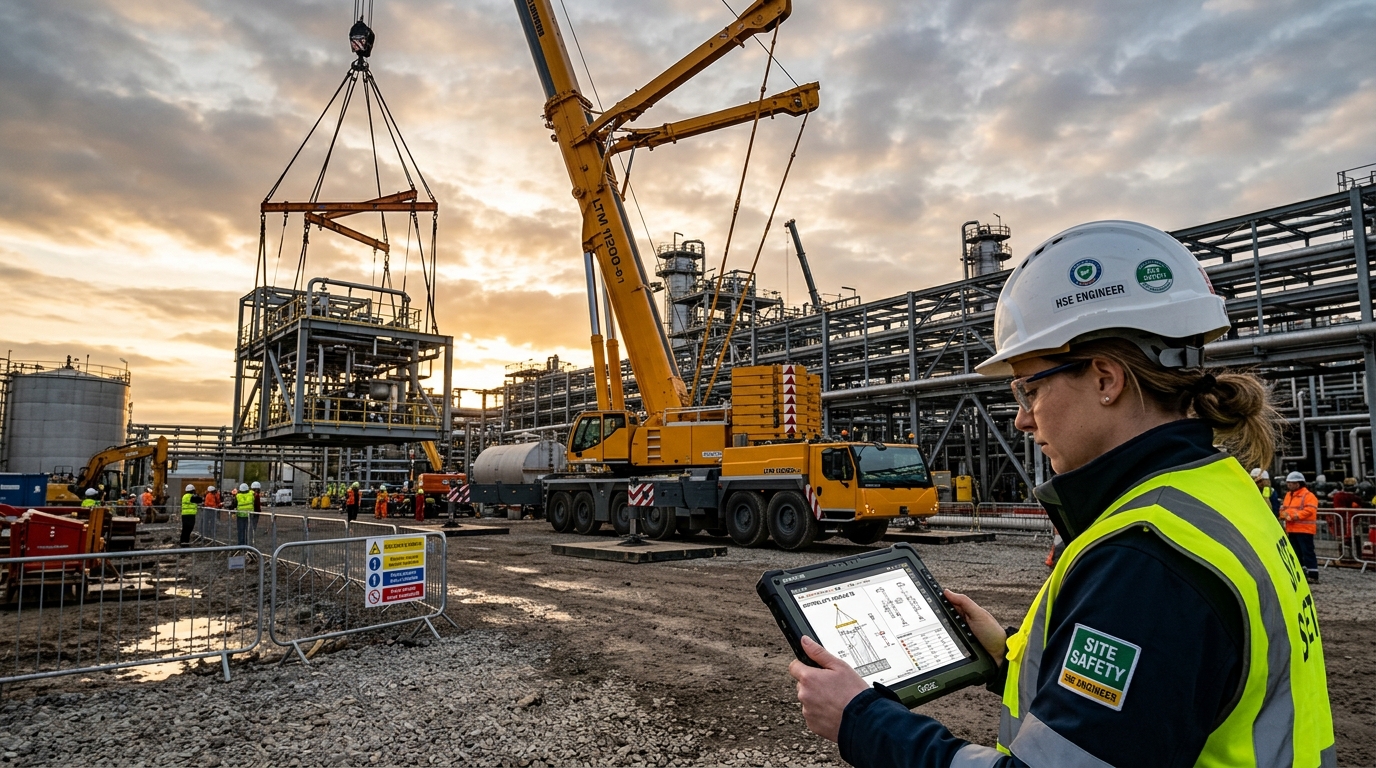
The Indonesian Ministry of Manpower (Kemnaker RI) issued SKKNI No. 246 of 2023 to establish rigorous qualification benchmarks for Lifting Engineers and Rigging Supervisors. In heavy industries like Oil & Gas, Mining, Petrochemical, and Civil Infrastructure, improper lift planning accounts for over 42% of crane-related catastrophic incidents.
1. Critical Lift Triggers Under Current HSE Guidelines
An operation is formally designated as a Critical Lift when it fulfills one or more of the following hazard thresholds:
- Safe Working Load (SWL) Utilization: Total gross load exceeds 75% of the crane’s net rated capacity at the required radius.
- Tandem / Multi-Crane Lift: Two or more cranes hoisting, rotating, or tailing a single synchronized load.
- High-Risk Environment: Hoisting directly over energized gas/oil pipelines, live high-voltage electrical assets, or occupied facilities.
- Personnel Hoisting: Utilizing Kemnaker-certified man-baskets for elevated technical inspection.
- Adverse Environmental Exposure: Operations near coastal jetties with wind speeds exceeding 20 knots or challenging tidal swells.
2. Mathematical Formulations: Sling Tension & Angle Factor
A frequent error in field rigging is treating sling tension as simple load division across legs without accounting for the horizontal sling angle (θ).
T = (W / N) × (1 / sin θ)
When θ drops below 45°, the sling angle factor increases exponentially, risking sudden sling rupture and catastrophic dropped objects. Best practice under CTC-Indonesia guidelines mandates keeping θ ≥ 60° whenever head clearance permits.
3. Ground Bearing Pressure (GBP) & Outrigger Mat Calculations
More than 50% of crane tip-overs stem from uncompacted soil or undersized outrigger pads. To calculate the required steel/timber mat area (A):
Area Required (m²) = Maximum Outrigger Point Load (kN) / Permissible Soil Bearing Capacity (kN/m²)
Engineers must obtain geotechnical soil compaction reports (SPT/DCP testing) before positioning heavy hydraulic all-terrain or crawler cranes.
4. AI Rigging Automation: CTC Copilot in Action
CTC-Indonesia has integrated these complex calculations into our Enterprise HSE AI Platform. Rigging engineers can input crane load charts, hook weights, boom length, and radius parameters directly into the AI Rigging Copilot:
- Instant anomaly detection for overloaded outriggers and side-loading risks.
- Automated generation of bilingual Critical Lift Plans compliant with SKKNI 246/2023.
- Real-time wind gust threshold monitoring and emergency abort checklists.